A Fight Between Goliaths: Winners and Losers of the Online News Act
Sydney L. Forde (PhD) and Nelanthi Hewa (PhD)
As part of the Tech Lobby project, we have begun examining Meta, Google, and Amazon’s lobbying of the Canadian government during consultations for Bill C-18. This post centers on some of our preliminary findings meant to question who benefits from the introduction of the act.
The Online News Act (Bill C-18) became law on June 22, 2023 in Canada. Introduced in 2022, Bill C-18 set out “to ensure fairness in the Canadian digital news marketplace and for independent local news businesses, including rural and remote news organizations, by ensuring that news media and journalists receive fair compensation for their work” (Canadian Heritage, 2022). The way “fairness” was ensured under the Online News Act was through an attempt to safeguard the struggling Canadian journalism industry from platform imperialism perpetuated by big American tech companies and addressing the “market imbalance” of digital advertising revenues being captured by big tech gatekeepers, rather than traditional media organizations who had come to rely on such (Canadian Heritage, 2022). This positioning of journalism in need of saving, and big tech in need of slaying, led to commonplace framing of the policy debate as one of “David versus Goliath” (e.g. Loffreda, 2023).
David (journalism organizations) would be able to collectively bargain against Goliath (Meta and Alphabet) in order to regain a sense of “market balance” based on the amount of advertising dollars allotted to organizations. But, as many critical scholars, journalists and activists have noted, the distribution of funds has not been equal across journalism organizations. Those who have benefitted the most from the Online News Act are disproportionately large media conglomerates, leaving small, Indigenous, non-profit and local organizations, as well as freelance journalists, without support (Geist, 2024; Katz, 2023). Based on existing critiques of the ONA and similar news bargaining codes, as well as data retrieved from the Canadian Journalism Collective-Collectif canadien de journalisme (CJC-CCJ) on the distribution of funding to journalism organizations that demonstrate a clear privileging of large media organizations, we set out to critically examine the policy rationale behind the ONA. To do this, we examine lobbying efforts on “both sides” of Bill C-18, from tech companies Meta and Google challenging the act, as well as some of Canada’s largest news conglomerates advocating in favour of such. We position this analysis against a backdrop of normative ideals for journalism within a democracy, as well as the Bill’s articulated goals of “saving” journalism.
The Online News Act
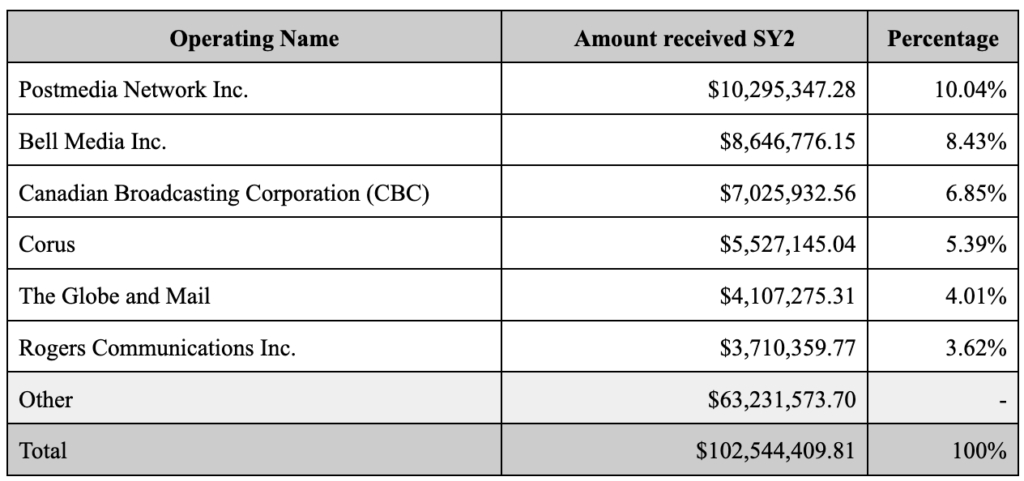
Bill C-18, which has been in effect since 2023, promises to regulate tech platforms and compensate news organizations for the purported economic benefit they bring news intermediaries. In theory, the Bill develops a framework for news organizations to bargain with news intermediaries for compensation. Qualifying Canadian news organizations must, among other stipulations, regularly employ two or more journalists in Canada (where regularly means a minimum of 8 weeks or at least 260 hours during the year in question) . Freelancers, contractors, and volunteers are explicitly excluded. According to the first report by the CJC-CCJ, the top 6 recipients of the first $100 million received $39,312,836.11 (or almost 40% of the total amount disbursed so far). They were (in descending order), Postmedia, Bell Media, the CBC, Corus Television, The Globe and Mail, and Rogers.
As critical media scholars, our instinct is to applaud attempts to regulate large tech companies, particularly as they have been so publicly resistant to Bill C-18 (or any measures threatening regulatory constraint). And yet, a closer look at the Bill and its subsequent impacts tell a different story. While originally promising to “improve” on the Australian Code (Carson et al., 2022), Canada’s Online News Act has faced a similar array of critiques from scholars, journalists and activists for the ONA’s privileging of large, existing media corporations over smaller, ethnic, and local outlets; for deepening journalism’s reliance on Big Tech; for excluding freelance and non-traditional forms of journalism and for re-enforcing journalism’s unstable reliance on advertising revenues (Bannerman, 2023a; 2023b; Gardner, 2022; Geist, 2023; Kahn, 2023; Katz, 2022; Winseck, 2022; Yu & Bannerman, 2025).
Beyond these critiques of the ONA’s speculated failures, the actual implementation and subsequent impact of the Bill has led to bargaining exemptions for the only two major news intermediaries that qualified: Google and Meta. Meta simply blocked news content on its platforms in response, opting out of hosting any content deemed “news” under the act, while Google was granted a five-year exemption from the ONA in exchange for agreeing to disburse $100 million annually to news organizations through the CJC-CCJ. The ONA, and news bargaining codes more broadly, clearly reflect a desire for regulation that both limits tech power and recognizes the importance of sustainable journalism in Canada. But, this type of intervention, we argue, only facilitates greater reliance on Big Tech and the further consolidation of power within an already concentrated news media market. How, then, might we make sense of this disconnect?
Normative Ideals for Journalism
We position this analysis against a backdrop of normative ideals for journalism, as demonstrated in the Bill’s articulated goals of “saving” journalism. We understand the normative role of journalism as an essential component to the establishment of cultural and political life. As described by the late media scholar Robert McChesney: “[a]ll democratic theory… is premised on the idea that democracy requires an informed, participating citizenry, and such a citizenry can only exist with strong and vibrant journalism” (McChesney, 2014, p. 97). This strong and vibrant journalism is bolstered, at least partly, by marginalised workers like journalists of colour and women journalists who have, not coincidentally, been at the centre of drives to unionise or increase worker protection. Journalistic ideals like democracy, free speech, and journalism for all remain dependent on a diverse media landscape reflective of the society it is meant to inform—that is, a diverse and democratic media requires more stable and equitable working conditions. This context establishes the stakes for news regulation in Canada.
Further, we understand the normative or expected role of policy as grounded in what Horwitz describes as the public interest theory of regulation. This is grounded in the belief that regulation is established in response to conflicts inherent in relations between the general public and private corporations. This is to say, the government is expected to step in on behalf of the public when corporations overstep. In terms of the journalism industry, many critical scholars have demonstrated that this must include addressing how journalistic ideals require material means.
Using these two expectations of different institutions—journalism and regulation—as normative benchmarks, we adopt critical frameworks to make sense of the contradictions seen in the ONA, which we argue neither prioritizes the democratic necessity of journalism, nor demonstrates regulatory action grounded in public interest. Instead, we find that the ONA prioritizes the interests of various giant corporations, in turn abandoning the institution of journalism altogether.
Critical Frameworks
We use two critical frameworks in our analysis of Bill C-18 to explore the political and economic interests of both Goliaths via federal lobbying efforts, and argue for smaller news organizations and independent workers as the true “David.”
Precarity and Freelancing
Contemporary journalism is produced in a contradictory environment: enormous amounts of content are created every day by a workforce whose pay and job security are dwindling. Cultural workers like journalists have been characterized as the new “‘precariat’—a neologism that brings together the meanings of precariousness and proletariat to signify both an experience of exploitation and a potential for worker solidarity across job titles and workplaces within the broader culture industries. “Precarity” captures both these “insecure forms of living and, simultaneously, new forms of political struggle” (Gill & Pratt, 2008, p. 3), or to describe the psychological and affective effects of precariousness, ones characterized by uncertainty and unease. While journalism is generally a more insecure form of work than in earlier years when newsrooms were more lucrative, precarious labor conditions also affect people of color and women disproportionately. As Cohen and Clarke (2024) argue, precarity, race, gender, and other markers of identity intersect to shape the experiences of journalists, particularly in an industry that remains overwhelmingly white. As the Canadian Association of Journalism’s most recent (2025) diversity study finds, diversity within the industry remains concentrated in junior and precarious roles.
Other scholars discussing precarity and “entrepreneurial journalism” have noted the growth of entrepreneurial journalism as an “industry buzz term” (Vos & Singer, 2016) that highlights the increase of self-motivated work from journalists who must raise a public profile (Hunter, 2016) and are encouraged to “do more with less” (Neilson, 2021). This context highlights that freelance, precarious, and otherwise insecure forms of employment are foundational to journalistic labour in Canada: not only is journalistic work becoming more diverse, but simultaneously a growing number of journalists and parajournalists find themselves working outside of traditional, full-time employment in newsrooms. Indeed, this transformation of employment is directly a result of the transformation of the industry due to tech platforms that Bill C-18 promises to redress.
Regulatory Rationale
The shortcomings of the journalism industry – specifically for the most precarious workers – juxtaposed with a policy meant to “save” journalism by privileging the very giants that already dominate the Canadian media landscape, highlights major contradictions in the normatively conceived public interest theory approach to regulation. Thus, we instead adopt a critical regulatory framework grounded in a Marxist approach to the role of the state. Marx and Engels explained that “The executive of the modern state is but a committee for managing the common affairs of the whole bourgeoisie” (Marx & Engels, 1848: 2002). This means to suggest that governments who prioritize the needs of capital are fundamentally incapable of simultaneously prioritizing the needs of the general public. Instead—and in favour of perpetuating an image of a public serving, reactive state – regulation works with giant corporations, not against them.
“Few regulatory policies have been pursued unless they proved acceptable to the regulated groups or served the interests of these groups”
– Edelman, 1985, p. 24
Baran and Sweezy (1966) explained this dynamic as the state functioning under monopoly capitalism, where “the function of the state is to serve the interests of monopoly capital” (pp. 65-66). In turn, this means that regulation is subject to the approval of the very groups meant to be regulated. Edelman (1985) explained what this looks like in practice, noting “few regulatory policies have been pursued unless they proved acceptable to the regulated groups or served the interests of these groups” (p. 24).
Using this critical lens, we examine documents gathered by The Tech Lobby using Access to Information requests. We have begun conducting a critical discourse analysis of documents, searching for examples that demonstrate insight into the relationship between tech companies and regulators, as well as the ways that tech companies discursively frame both themselves and their competitors in the Canadian media landscape.
Discussion
Winners & Losers
In scrutinizing the immense lobbying efforts put forth by a small group of corporate actors, we found the conception of news and news workers mobilised within the bill was reflective of these corporate interests. In contrast to the Bill’s framing of tech giants against vulnerable Canadian media organizations, the real “David” – actual journalism workers – were sidelined during the fight between Goliaths – that is, between tech giants and Canada’s most consolidated media organizations. Beyond the lack of inclusion of journalism workers at the actual bargaining table, newsworkers, many of whom are increasingly freelance, found themselves actively excluded from the Bill’s strict definitions of news organizations and full-time employees as its primary benefactors. Even before the Bill had passed (and the bargaining collective had been formed), the Parliamentary Budget Officer “estimated that over seventy-five percent of the generated revenue would go to broadcasters such as Bell, Rogers, and the CBC” (Katz, 2023, p. 359).
While the fund is regulated and therefore, does not grant Google free reign over the terms for which publishers receive money and how much (a small win), the fact that freelancers are excluded entirely from the bargaining code is a clear loss. Further, it demonstrates that regulators are not taking seriously the shifting landscape of journalistic work. As highlighted above, freelancers and other workers outside of full-time employment with newsrooms are both a growing population and one experiencing various degrees of precarity and instability. Despite this need for regulation that responds to a crisis of underpaid and uncertainly employed journalists, large organizations such as the CBC, Postmedia, and other news conglomerates that dominate the Canadian news landscape found themselves the largest beneficiaries of the Online News Act.
Three Little Guys
The framing of media giants such as Bell, Postmedia and Rogers – some of the largest beneficiaries of the ONA as highlighted above – as desperately in need of funding while sidelining smaller journalism organizations is clearly an attempt to paint the entirety of the Canadian news industry with the same brush. That’s to say, in extending the very real Canadian journalism crisis to the largest media conglomerates in the country – the very corporations contributing to the decline of local journalism throughout Canada – the ONA has somehow extended this “underdog” title to every organization generating news, while limiting the benefits of payouts to the largest of such.
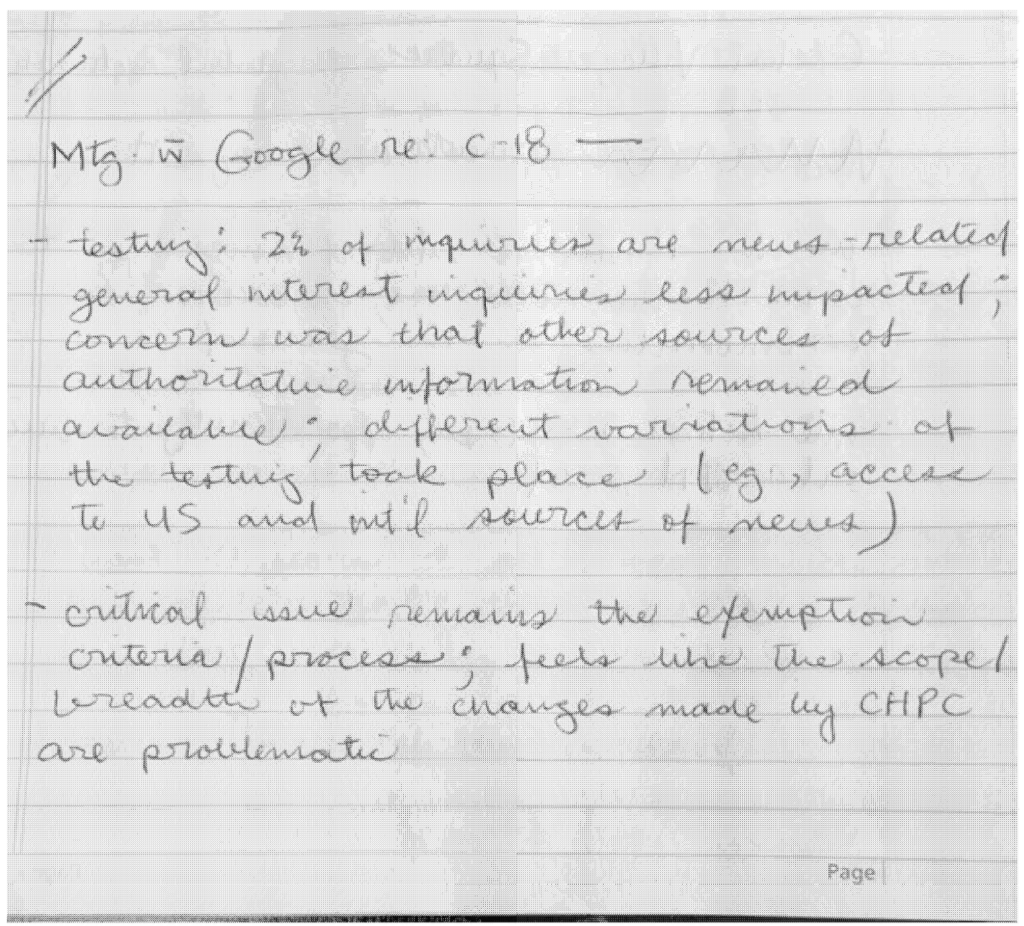
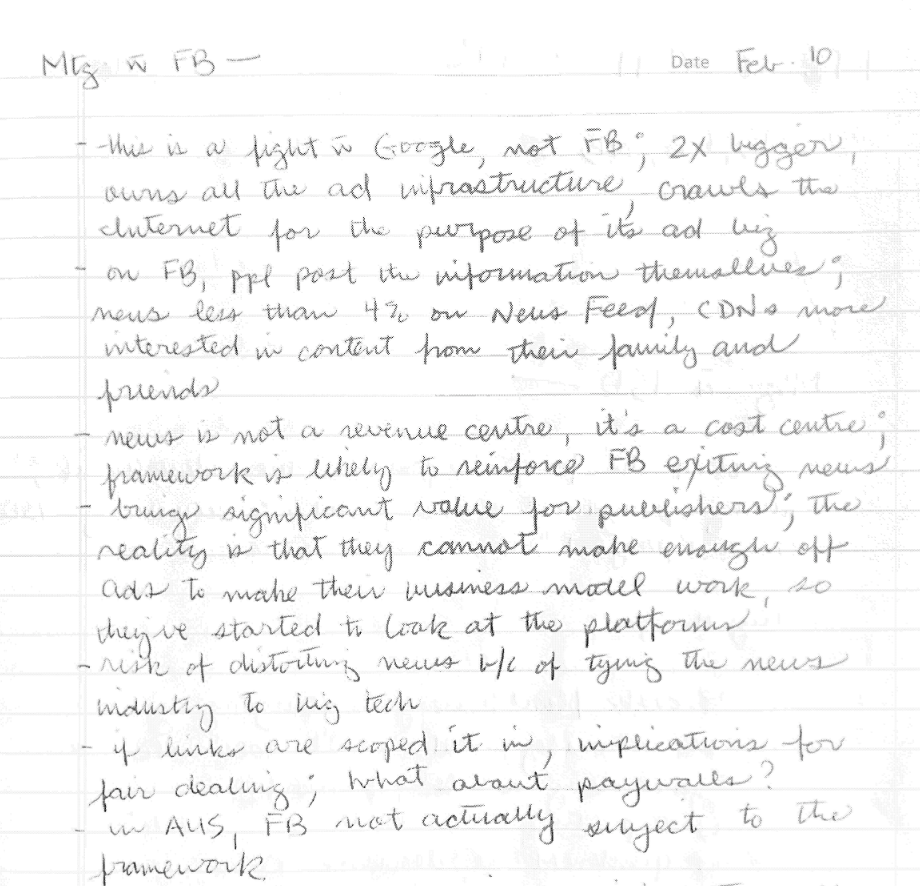
Further, notes and company submissions obtained by The Tech Lobby reveal significant lobbying efforts by Meta and Google in particular. From meeting notes with Meta that feature the company’s attempts to to frame itself as a small fish in the news platform pond (contra Google) (Canada, 2022a) to tech companies tacitly admitting and recognizing the effects of platformization on the news industry while disavowing their own role (Government of Canada, 2023). We find that Meta and Google took radically different approaches to framing their influence on Canadian media, with Meta downplaying its role while Google highlighted its position as a defender of the “free and open internet” – arguing that Bill C-18 and payment for links “literally breaks the open web” (Canada, 2022b).
David or Goliath?
As the role of AI in journalism continues to grow, policy that seeks to protect Canadian journalism is increasingly necessary. Early research has shown that referral traffic from Google has decreased due to AI (Newman, 2026), while internal documents unsealed as part of The New York Times’ ongoing (at time of writing) lawsuit against Microsoft and OpenAI show the latter admitting that AI poses “an “existential threat” to publishers” (Reed, 2026). On the one hand, this is a clear challenge to tech platforms’ arguments that they are helping, rather than hurting, Canadian media organizations by increasing traffic. Our broader argument, however, remains unchanged: robust policy responses to the journalism crisis must a) recognize the changing landscape of journalistic work and b) resist fostering dependence on unfettered Big Tech. In the case of Bill C-18 and in contrast to the framing of tech giants and vulnerable Canadian media organizations, we argue that the real David in the fight against Goliath wasn’t invited into the room: journalism workers, many of whom are increasingly freelance, found themselves left out of the Bill’s strict definitions of news organizations and full-time employees as its primary benefactors.
Fundamentally, we argue that the treatment of journalism as a market commodity exacerbates the problems of both outsized tech power and influence, and continued imbalance and inequality between Canadian news media players.
We characterize the Bill as an exemplary result of lobbying between giants (i.e. tech companies and mainstream media corporations). Senators in favour of the Bill framed it as as act that would “encourage digital platforms to enter into voluntary commercial agreements between themselves and the news organizations whose content they post on their sites,” revealing the reluctance of the Canadian government to actively intervene in and regulate the tech industry and instead resorting to merely “encouraging” it. Bill C-18 quietly accepts two premises: that advertising is needed to fund journalism (rather than additional public funding, for example), and that the only way to regulate tech companies is via voluntary bargaining codes (rather than taxation, for example). Fundamentally, we argue that the treatment of journalism as a market commodity exacerbates the problems of both outsized tech power and influence, and continued imbalance and inequality between Canadian news media players.
Dr. Sydney Forde is a research affiliate at the University of Pennsylvania’s Annenberg School for Communication in the Media Inequality and Change (MIC) Center. She studies the critical political economy of communications, exploring power and contradictions within both media and policy spaces, and applies critical theory to the role of the state.
Dr. Nelanthi Hewa is a research affiliate at the University of Pennsylvania’s Annenberg School for Communication. She researches journalism labour in Canada, sexual violence news reporting, and digital platforms. Her work can be found in Journalism Practice, Feminist Media Studies, and others.
References
Bannerman, S. (2023a). Inadequate Online News Act regulations pay lip service to journalistic independence. The Hill Times. https://www.hilltimes.com/2023/10/25/inadequate-online-news-act-regulations- pay-lip-service-to-journalistic-independence/400721/
Bannerman, S. (2023b) “The Online News Act could give Google and Meta too much influence over Canadian news organizations.” The Conversation. Available at https://theconversation.com/the-online-news-act-could-give-google-and-meta-too-much-influence-over-canadian-news-organizations-201080
Baran, P. A., & Sweezy, P. M. (1968). Monopoly capital: An essay on the American economic and social order. New York: Monthly Review Press.
Canada, G. of. (2022a). Access to Information Request A-2023-00490 submitted to Canadian Heritage for records related to a “All records relating to registered lobbying communication #521760 involving Pablo Rodriguez, Minister, Canadian Heritage (PCH) and Amazon Canada Fulfillment Services, ULC on January 31, 2022. Subject(s): Arts and Culture, Broadcasting All records relating to registered lobbying communication #521762 involving Matthew Gray, Policy Advisor, Canadian Heritage (PCH) and Amazon Canada Fulfillment Services, ULC on January 31, 2022. Subject(s): Broadcasting All records relating to registered lobbying communication #522793 involving Pablo Rodriguez, Minister, Canadian Heritage (PCH), John Matheson, Chief of Staff, Canadian Heritage (PCH) and Netflix Services Canada ULC on February 04, 2022. Subject(s) Arts and Culture. All records relating to registered lobbying communication #522228 involving John Matheson , Chief of Staff, Canadian Heritage (PCH), David Hurl, Director of Policy, Canadian Heritage (PCH) and Google Canada Corporation on January 31, 2022. Subject(s) Arts and Culture. All records relating to registered lobbying communication #524640 involving Brian MacKay, Senior Policy Advisor, Minister’s Office, Canadian Heritage (PCH), Pablo Rodriguez, Minister, Canadian Heritage (PCH), John Matheson, Chief of Staff, Minister’s Office, Canadian Heritage (PCH), Julie Harb, Policy Advisor, Minister’s Office, Canadian Heritage (PCH), Owen Ripley, Associate Assistant Deputy Minister, Cultural Affairs, Canadian Heritage (PCH) and Facebook Canada Ltd. On February 10, 2022. Subject(s): Industry.” Canadian Heritage. http://open.canada.ca/en/access-to-information
Canada, G. of. (2022b). Access to Information Request A-2024-00077 submitted to for records related to a registered lobbying communication (Lobbying communication #534870) involving Google Canada Corporation lobbyist Sabrina Geremia and Owen Ripley (Associate Assistant Deputy Minister, Cultural Affairs, Canadian Heritage (PCH)), Ron Ahluwalia (Director Of Policy, Canadian Heritage (PCH)), Matthew Gray (Policy Advisor, Canadian Heritage (PCH)), Julie Harb (Policy Advisor, Canadian Heritage (PCH)) on 05 05, 2022. Canadian Heritage. http://open.canada.ca/en/access-to-information
Cohen, Nicole, and Shannon Clarke. “Diversity through Precarity? Gender, Race, and Work in Digital Journalism.” Canadian Journal of Communication 49, no. 2 (2024): 175–200. https://doi.org/10.3138/cjc-2022-0038.
Edelman, M. J. (1985). The symbolic uses of politics. University of Illinois Press.
Gill, Rosalind, and Andy Pratt. “In the Social Factory?: Immaterial Labour, Precariousness and Cultural Work.” Theory, Culture & Society 25, nos. 7–8 (2008): 1–30. https://doi.org/10.1177/0263276408097794.
Katz, Ariel. “Sedating Democracy’s Watchdogs: Critical Reflections on Canada’s Proposed Online News Act.” Columbia J. Law Arts 46, no. 3 (2023). https://doi.org/10.52214/jla.v46i3.11234.
Gardner, S. (2022). Sue Gardner: Bill C-18 is Bad for Journalism and Bad for Canada. McGill Max Bell School of Public Policy. https://www.mcgill.ca/maxbellschool/ max-policy/c-18